
This article was originally published on TechSoda
The AI boom risks becoming a locust swarm—devouring memory resources for data centers while starving the edge devices needed to turn AI into real-world value.
As memory makers chase higher-margin data center demand, Silicon Motion's Nelson Duann warns that shortages and soaring costs for automotive, industrial and consumer storage risk starving the very edge devices needed to turn AI investment into real-world value.
While much of the discussion surrounding Apple's reported interest in sourcing memory chips from China's CXMT and YMTC has focused on geopolitics and supply-chain diversification, industry insiders warn it may signal a deeper structural problem: the AI boom is drawing semiconductor resources toward high-margin data centers at the expense of the edge devices needed to turn AI investment into real-world value.
The risk goes beyond soaring memory prices. If shortages and rising costs force smartphone, PC, automotive and industrial-device makers to postpone upgrades, cut specifications or retreat to older architectures, AI could end up eroding the very markets it ultimately depends on for deployment and returns.
"I want to make an urgent appeal: we must address this excessive imbalance and sustain demand for edge devices—consumer electronics, smartphones, PCs, automobiles and even robots—because these are ultimately where AI will be deployed, generate returns and realize its true value," Nelson Duann, Senior Vice President of Silicon Motion's Edge and Automotive Storage Business Unit, told TechSoda.
Silicon Motion is the world's leading supplier of NAND flash controller chips.
A 'Locust Swarm' Devouring Semiconductor Resources
Duann compared the current concentration of semiconductor resources around data centers to a locust swarm consuming everything in its path.
As companies rush to invest in AI infrastructure and semiconductor resources continue flowing toward data centers, he warned that the industry risks overlooking the health of the broader ecosystem.
"Why do locust plagues always come in cycles rather than last indefinitely?" Duann said. "Because after consuming resources on a massive scale, eventually even the locusts themselves cannot survive."
The economic incentives driving the shift are understandable.
"When the profit margin on HBM is three, five or even ten times that of consumer-grade products, any rational company would make the same choice," Duann said.
But therein lies what he sees as a dangerous contradiction: AI ultimately depends on the markets now being squeezed by the AI infrastructure boom.
Autonomous vehicles require reliable automotive storage to process enormous volumes of road and sensor data at the edge. Smart factories depend on industrial-grade NAND for real-time data collection and processing. AI PCs and AI smartphones require affordable and readily available memory and storage before AI capabilities can reach hundreds of millions of consumers.
"We are witnessing a paradox," Duann said. "AI needs the edge, yet AI is systematically undermining the very foundation of storage demand that the edge depends on."
The Risk of an Edge-AI Demand Cliff
Duann warned that continued shortages and elevated prices could eventually create a "demand cliff" for edge devices and automotive applications.
Once customers abandon upgrades or manufacturers redesign products around lower memory requirements, he argued, recovering that lost demand could take years.
In fact, we are probably witnessing a contraction of that demand. IDC forecasts that global PC shipments will decline 11.3% year over year in 2026, with market conditions expected to deteriorate progressively through the fourth quarter, when the decline could reach as much as 20% year over year. The primary driver is a persistent memory shortage, with no meaningful relief expected before the end of 2027.
Meanwhile, TrendForce forecasts that global smartphone production will fall 15% - 20% year over year in 2026. The key issue is tightening memory supply amid surging AI-related demand and constrained capacity, as manufacturers prioritize higher-value server and AI applications, putting additional pressure on memory availability and costs for mobile devices.
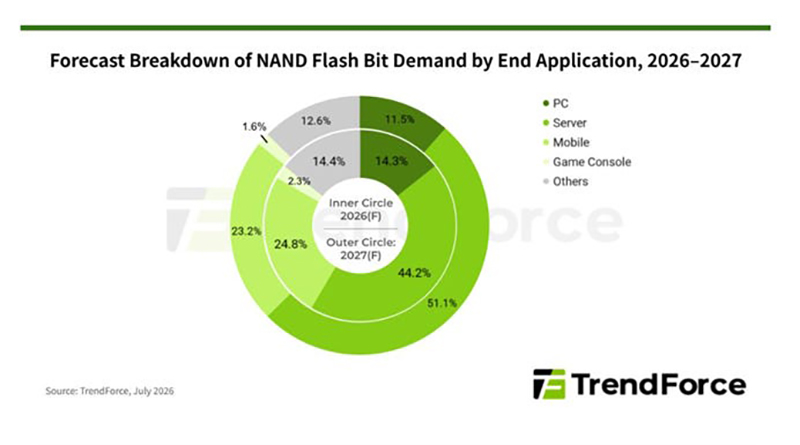
The problem cannot necessarily be solved quickly through additional capital expenditure. Building new semiconductor capacity requires long lead times; securing land, constructing fabs, installing equipment, and qualifying production can take years.
Duann therefore argues that the more immediate solution is a more balanced allocation of existing capacity.
Rather than allowing the overwhelming majority of incremental resources to flow toward the most profitable data center applications, he believes memory manufacturers should preserve meaningful capacity for automotive, industrial and consumer markets—even when those products generate lower margins.
"Data centers don't need to consume 99.5% of the available capacity. They need to use memory and storage more efficiently," said Duann. "Eighty percent should be enough. The remaining 20% should be allocated to less profitable edge devices so that those markets can survive. That is extremely important."
For Duann, this is not an argument against investment in AI infrastructure. It is an argument for protecting the entire AI ecosystem.
"The healthy development of this industry requires a complete ecosystem—from the cloud to the edge, from data centers to every vehicle, every factory and every smartphone."
AI Infrastructure Is More Than Data Centers
The debate is often framed as a competition for scarce semiconductor resources, but Duann argues that cloud and edge AI should not be viewed as a zero-sum game.
"When we help automotive customers lower storage costs and accelerate the adoption of intelligent driving, we are actually expanding the range of AI applications," he said.
Likewise, enabling industrial systems to operate reliably in extreme environments demonstrates that AI can move beyond climate-controlled data centers. Making AI capabilities affordable in consumer electronics, meanwhile, helps broaden access to the technology.
The danger is that market forces could create the opposite outcome.
Memory manufacturers naturally have incentives to prioritize products offering the highest returns. But if shortages and higher prices force automotive, industrial, and consumer-device manufacturers to postpone AI upgrades, today's profit optimization could contribute to tomorrow's demand contraction.
From 'Data Bridge' to 'Value Amplifier'
Against this backdrop, Silicon Motion is seeking to redefine the role of the storage controller.
Rather than functioning primarily as a "data bridge" between NAND flash and the host processor, Duann describes the controller as a "value amplifier" capable of extracting greater performance, reliability and longevity from available NAND resources.
Through technologies including LDPC error correction and RAID, controllers can help standard NAND meet the demanding endurance and performance requirements of automotive and industrial applications.
Power and thermal management are another priority. Silicon Motion says idle power consumption can be reduced to the milliwatt level, while dynamic thermal-management algorithms can help SSDs operate reliably across temperatures ranging from -40°C to 105°C.
For automotive applications, functional safety and cybersecurity also need to be incorporated from the beginning of the design process, including requirements associated with ISO 26262, ISO/SAE 21434 and AEC-Q100.
Controllers could also play a growing role in lightweight edge preprocessing, including data compression and structured filtering, reducing the amount of data that must be transmitted from edge devices to the cloud.
The broader objective is to get more value from available NAND rather than relying solely on ever-greater memory capacity.
Building a 'Resilience Community'
Technology alone, however, cannot solve the capacity imbalance.
Duann argues that controller suppliers, NAND manufacturers, module makers and end customers need to cooperate much earlier in the product-development cycle.
For controller suppliers, that means participating in the definition and validation of next-generation NAND technologies as much as two years before commercial deployment. Doing so could give edge applications greater visibility when NAND manufacturers make future capacity-allocation decisions.
Module makers could contribute through greater supply-chain transparency, including six-month capacity alerts and real-time inventory coordination, reducing the risk that information gaps turn tight supply into panic-driven shortages.
Automotive and industrial customers should also participate earlier in system design. Collaboration on emerging vehicle architectures—including zonal architectures and zonal controllers—could reduce the likelihood of costly redesigns when component availability changes.
Together, Duann describes these relationships as an industry "resilience community."
Safeguarding AI's Last Mile
Silicon Motion's warning ultimately goes beyond the memory-chip cycle.
The commercial value of AI will not be determined solely by how many GPUs, HBM stacks or data centers the industry can build. It will also depend on whether AI inference can be deployed economically across vehicles, factories, robots, smartphones, PCs and billions of other edge devices.
Those applications do not necessarily require the fastest memory available. They require the right storage: cost-effective solutions capable of delivering long-term reliability, low power consumption and stable performance under demanding operating conditions.
Silicon Motion is therefore positioning controller innovation as a strategic leverage point for protecting what Duann calls the "last mile" of AI inference deployment.
By working with NAND manufacturers, module partners and end customers, the company aims to ensure that AI does not remain concentrated in hyperscale data centers, but reaches the physical devices where it can deliver real-world value.
The industry's challenge, Duann argues, is ultimately one of balance: maximizing today's AI infrastructure opportunity without consuming the resources needed to create tomorrow's AI demand.
Because if AI needs the edge to realize its value, starving the edge may eventually mean starving AI itself.
お問い合わせ