As AI infrastructure grows, most of the attention naturally goes to GPUs, high-speed networking, and large-scale storage. But one essential part of the system is often treated as an afterthought: the boot drive.
In cloud and enterprise AI environments, boot drives do much more than start a server. They help determine how quickly systems come online, rejoin a cluster, and return to active workloads after maintenance or failure. That makes them central to uptime, resilience, and overall fleet efficiency.
This is why boot storage has become a strategic issue for AI-era data centers. Modern AI systems are no longer simple server deployments. They bring together CPUs, GPUs, accelerators, orchestration software, networking, and distributed storage across large and complex environments. The boot drive supports trusted boot, system initialization, configuration management, and the reliable startup of the services that keep the platform running.
AI workloads also put new pressure on cloud infrastructure. Providers need to bring nodes online quickly, recover from failures without delay, and keep behavior consistent across thousands of systems. To do that, boot drives need low latency, high IOPS, strong endurance, and dependable security. When boot storage slows down, the effects show up quickly: longer recovery times, lower GPU utilization, and higher operating costs.
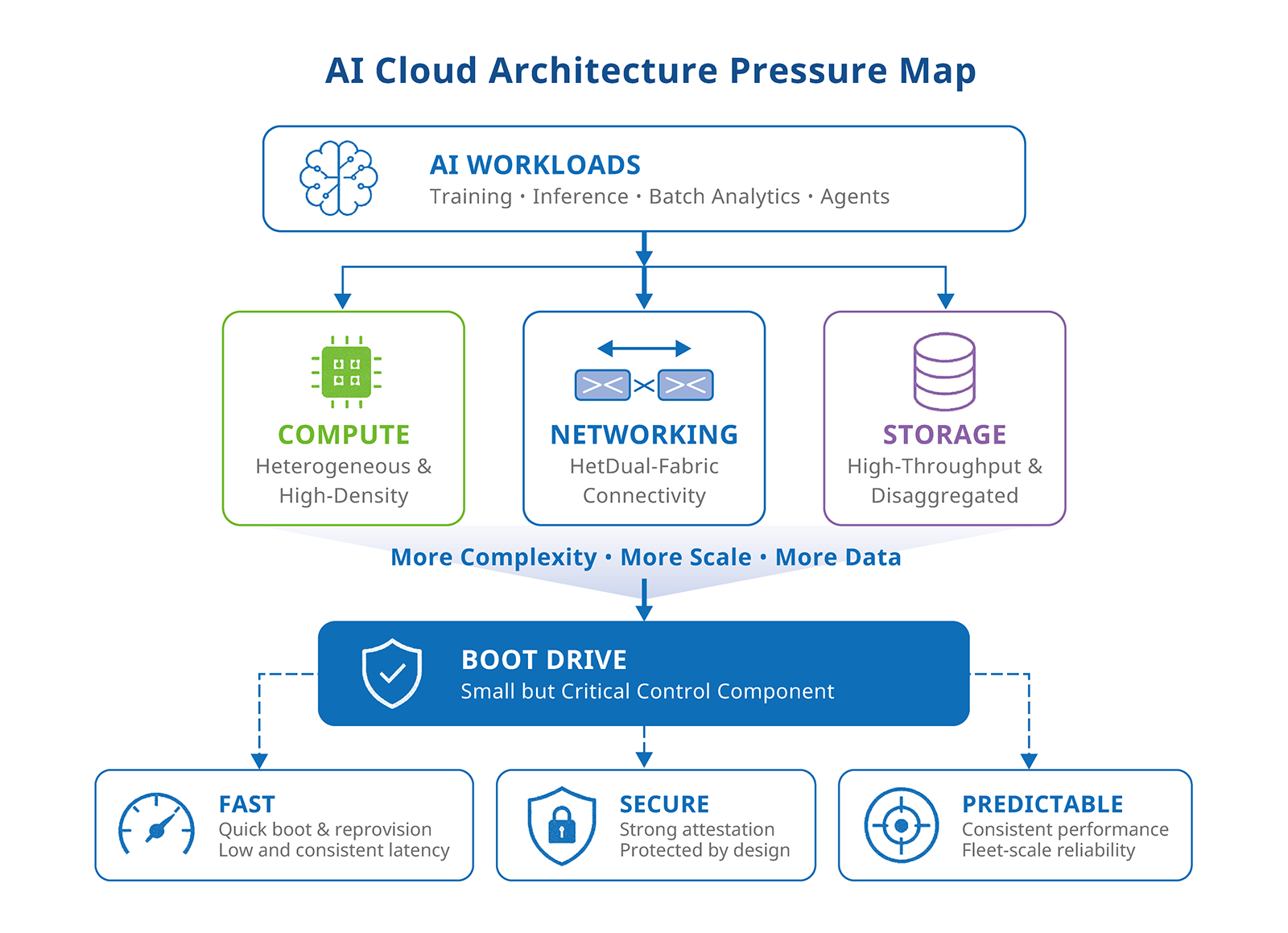
In our latest whitepaper, Silicon Motion makes the case that boot drives in AI data centers should be PCIe NVMe SSDs. Compared with mechanical drives, SSDs deliver the speed and consistency needed for rapid boot cycles, frequent reprovisioning, and continuous management activity. They also help maintain predictable performance in environments where even short delays can affect orchestration and cluster availability.
Silicon Motion's enterprise PCIe NVMe boot SSD solutions are built for these AI infrastructure demands. Their controller and firmware capabilities are designed to support fast, predictable boot performance, power-loss resilience, secure boot, and large-scale manageability. For cloud providers operating at scale, these are not optional extras. They are part of the operational foundation that keeps AI systems secure, efficient, and available.
In today's AI data centers, the boot drive is not a commodity. It is a control point. High-capacity storage may serve data and model workloads, but boot storage anchors the system's state, identity, and ability to recover. That role becomes even more important as AI factories become more distributed, more heterogeneous, and more dependent on automation.
For AI infrastructure teams, the takeaway is clear: boot drives should be chosen for IOPS, reliability, endurance, and security—not just capacity. That decision has a direct impact on uptime and service quality. If you are building or operating AI infrastructure, the boot drive is no longer a background component. It is a foundational part of AI platform performance.
Download our whitepaper, Boot Drive Requirements in Cloud AI Architectures, to explore the key design considerations for enterprise boot storage and its growing role in AI infrastructure.
