
The need for stable embedded storage across extended service lives
Long-service embedded platforms stay in the field for ten years or more. Once deployed, they are rarely revisited, so component behaviour has to remain stable over that entire period.

Initial qualification only reflects the device at that point in time. A later revision in the supply chain can change timing margins, shift ECC headroom, or alter background operations such as wear levelling. These changes do not show up in standard validation but can surface later as intermittent errors, increased latency, or unexpected recovery events under real operating conditions.
Embedded storage is sensitive because behaviour depends on how the controller, NAND, firmware, and power conditions interact in practice, not in isolation.
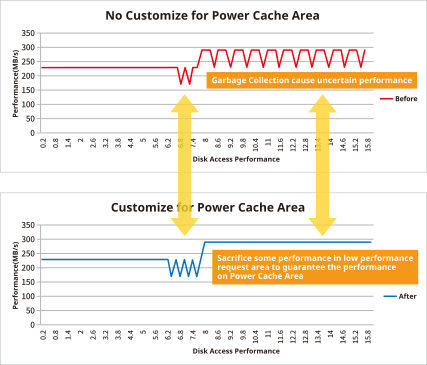
A change in any one of these layers can shift latency, reduce ECC margin, or alter background activity such as garbage collection and wear levelling. These effects are not always visible during validation. They tend to appear under stress, for example during sustained writes, low voltage events, or at temperature limits, where background operations compete with host access and error rates begin to rise.
The commercial flash market moves quickly. NAND processes shrink, controllers change, firmware is revised. These updates reduce cost and increase density, but they also change device behaviour. That creates a mismatch with long-life designs, where the expectation is that a qualified device behaves the same throughout its service life.
Storage selection happens early because it has to. Devices are qualified under defined conditions, but those conditions never fully represent the field. Once deployed, systems see temperature cycling, unstable power, vibration, and uneven write patterns. Under these conditions, failure mechanisms such as read disturb, retention loss, and write amplification dominate. Latency variation increases, ECC margin is consumed more quickly, and background operations begin to interfere with host access.
At that point, nominal performance figures are no longer relevant. What matters is how the storage behaves under sustained stress, and whether that behaviour remains stable over time.
Integrated storage in long-life designs
Using discrete NAND and controllers introduces variables that are difficult to control over time. NAND revisions, controller changes, and firmware updates do not always behave the same way as the original qualified configuration.
Integrating the controller and NAND into a single managed device reduces that dependency. Flash management, ECC, and firmware are developed and validated together, rather than relying on external pairing. This limits the risk of behavioural changes being introduced through component substitution later in the lifecycle.
For long-service systems, this matters because qualification is tied to a defined device configuration, not just an interface. Changes in NAND generation or process can affect error rates, endurance characteristics, and latency behaviour. When these are managed within the device, the impact on the host system is contained.
The Ferri family follows this approach, with controlled BOM configurations and lifecycle management. Devices are not treated as drop-in interchangeable parts across different NAND revisions, which helps maintain alignment between qualified and production units over time.
Managing NAND wear and data integrity
NAND characteristics degrade with program/erase cycling and retention time. Raw bit error rates increase, retention margins reduce, and read disturb accumulates with repeated access.
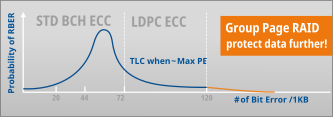
FerriSSD addresses this through NANDXtend, which uses LDPC error correction alongside internal data protection mechanisms to maintain data integrity as NAND wears. ECC strength and management strategies are adjusted within the controller to extend usable life.
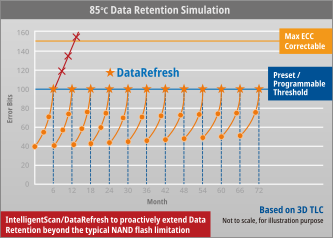
Background management is also used to manage degradation. IntelligentScan monitors block condition and error rates to identify areas approaching endurance limits. DataRefresh relocates data to maintain retention margins and reduce the impact of read disturb over time.
These mechanisms operate within the device and are transparent to the host, reducing the need for system-level management of NAND ageing effects.
Behaviour under unstable power conditions
Program or erase operations can leave mapping tables or metadata in an inconsistent state.
If not handled correctly, this can result in corrupted address mapping, inaccessible data, or device-level recovery events.
FerriSSD includes internal mechanisms to maintain mapping integrity during power disturbance and to restore a consistent state on the next power-up. The exact implementation varies by device, but the objective is to prevent corruption of critical metadata structures during incomplete operations.
Security at device level
Storage integrity also depends on protecting the device from unauthorised modification.
FerriSSD supports security features such as secure boot, firmware authentication, and hardware-based encryption, depending on the specific model. These features allow integration into system-level security architectures where trust in the storage device is required.
Different roles within the same system
Embedded platforms often include multiple storage requirements. High-performance subsystems benefit from PCIe NVMe-based FerriSSD devices, where throughput and latency are priorities. Control subsystems, with tighter constraints on power and footprint, are typically served by Ferri-eMMC devices compliant with the eMMC 5.1 standard.
Using devices from the same product family can help simplify system integration, qualification, and sourcing by providing consistent lifecycle management, support, and storage architecture across different parts of the system. While individual subsystems may still require additional validation to meet specific interface requirements, functional specifications, or industry certifications, a common storage platform can help reduce development complexity and improve long-term maintainability.
Maintaining alignment over time
The challenge in long-life systems is maintaining alignment between initial qualification and later production.
Component-level changes can introduce differences in latency behaviour, error rates, and background management activity. These changes are not always visible immediately but can lead to instability over time.
Storage devices with controlled configurations and defined lifecycle support reduce this risk. The behaviour validated during qualification remains representative of production units, limiting the need for requalification and reducing the likelihood of field issues linked to component variation.
This also simplifies system design and support. Software and hardware can be developed against stable device characteristics without needing to account for variation introduced over time.
Long-term behaviour over peak performance
In long-service systems, peak performance is less important than stable operation over time.
Silicon Motion's Ferri family is designed to manage NAND behaviour internally and maintain alignment with validated performance characteristics across the product lifecycle. Integration, lifecycle control, and internal management of NAND degradation support reliable operation under long-term deployment conditions.
That alignment determines whether a system continues to operate as expected or begins to show intermittent faults that are difficult to diagnose once deployed.
Contact Us