
In recent years, the performance bottlenecks of legacy memory card interfaces have become increasingly apparent, driven by the surging data transfer demands of 8K UHD video, professional-grade photography, and next-gen flagship gaming consoles.
SD Express emerged against this backdrop as a revolutionary breakthrough in SD card specifications. With performance comparable to SSDs, it has fundamentally redefined storage standards for portable devices. In this significant technological transformation, Silicon Motion, as a long-standing core member of the SD Association, has played a pivotal role in advancing industry adoption through forward-looking strategic positioning and deep technical expertise.
The Beginning of Transformation: A Forward-Looking Proposal in 2015
The story begins in 2015. At that time, the mainstream standards in the SD card market were still UHS-I and UHS-II. While UHS-II boosted transmission speeds by adding pins, its architecture was already approaching its physical limits, making it difficult to meet the exponentially growing performance demands of the future.
The industry stood at a crossroads: Should it continue to patch the existing architecture, or seek an entirely new path?
Wallace Kou, Silicon Motion's President & CEO, leveraging his keen market insight to anticipate the future demand for higher I/O performance in devices and recognized that PCIe technology - with its high bandwidth, low latency, and excellent scalability - was emerging as the mainstream interface standard for both PCs and mobile devices.
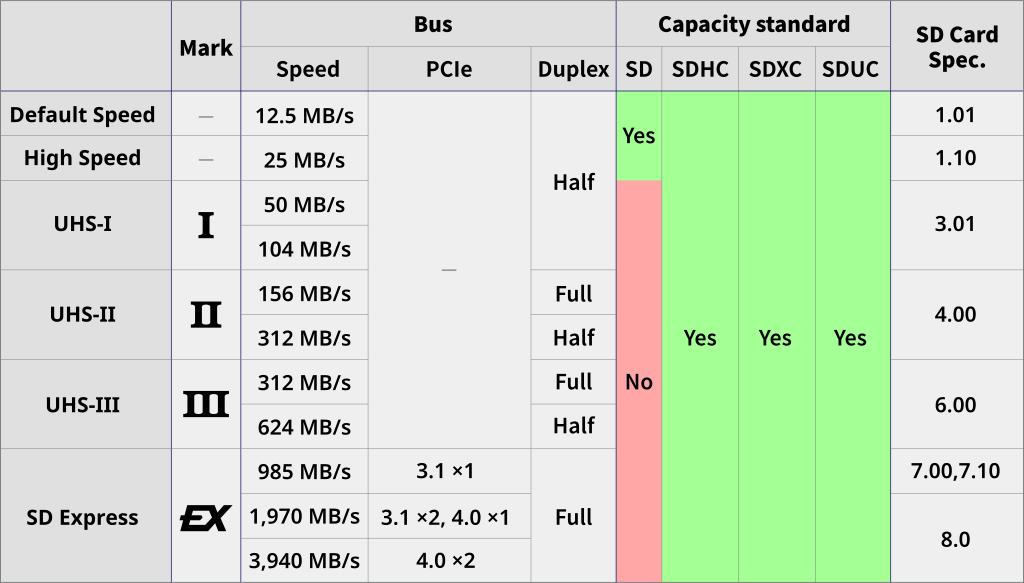
Therefore, during the SDA Board of Directors meeting that year, he formally proposed a groundbreaking strategic initiative - to fully integrate the mature, high-speed PCIe interface and its accompanying NVMe protocol into the SD specification.
The strategic significance of this proposal lay in breaking away completely from the constraints of the legacy SD bus architecture, bringing SD cards directly into the high-performance "PCIe ecosystem" aligned with mainstream computing platforms. This move unlocked entirely new possibilities for the future development of SD cards. Ultimately, this concept provided a clear and viable technical direction for the eventual establishment of the SD Express standard.
From Concept to Realization: Laying the Foundation for Critical Technologies
Turning a revolutionary idea from concept into realization requires overcoming numerous engineering challenges. Fully integrating PCIe/NVMe technology - originally designed for PC platforms - into SD cards with stringent constraints on power consumption, heat dissipation, and form factor was an almost impossible task.
After the SDA approved this concept and initiated the technical feasibility study, Silicon Motion quickly established a team to actively engage in R&D. Silicon Motion's engineers had to address a series of technical challenges, including how to maintain PCIe signal integrity within the constrained SD card form factor, how to optimize the controller to support the NVMe protocol under ultra-low power consumption, and how to ensure seamless backward compatibility with existing UHS-I host devices.
Leveraging over two decades of profound expertise in the controller industry, Silicon Motion took the lead in launching a "controller-level" product prototype and early-stage technical validation plan. This move fully demonstrated to the entire industry that PCIe-enabled SD cards are not only technically feasible but also have significant commercial development potential.
Leading a New Era: SM2708 Drives Industry Ecosystem Development
Leveraging its in-depth research and continuous contributions to SD specifications since joining the SDA in 2002, Silicon Motion once again seized the opportunity as the SD Express standard matured and market demand surged, launching the world's first SD Express 8.0 controller - SM2708.
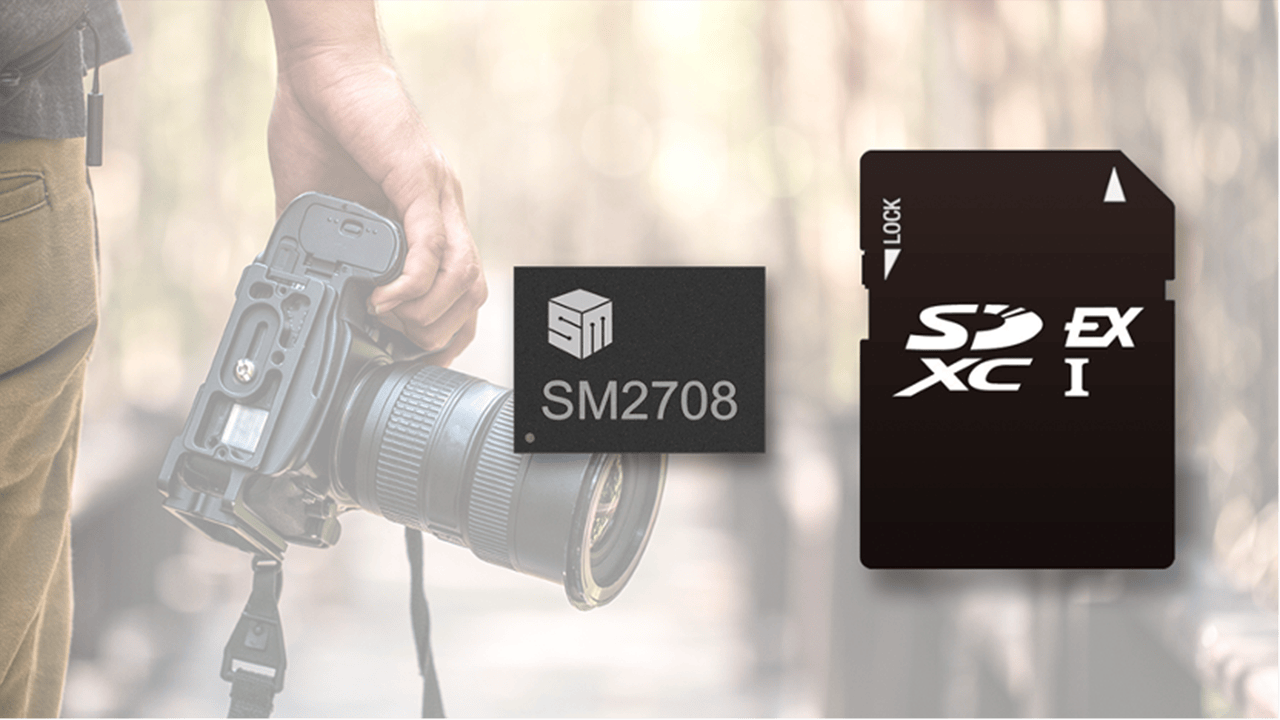
The launch of the SM2708 marked a milestone in the transition of SD Express from a "standard" to a "product."
In terms of technical specifications, the SM2708 fully complies with the SD 8.0 specification, supports PCIe Gen3 x2 lanes, and incorporates the high-performance NVMe 1.4 specification, enabling theoretical read/write speeds of up to 1.7 GB/s, thereby delivering ultra-fast performance on par with embedded SSDs.
In terms of technical advantages, the SM2708 integrates Silicon Motion's proprietary LDPC error correction code (ECC) technology, end-to-end data path protection, and an advanced power management mechanism, ensuring data stability and reliability during high-speed transmission.
Leveraging its leading performance, high stability, and proven mass-production capability, the SM2708 quickly became the preferred solution for numerous Tier-1 global storage brands. Major industry leaders including Samsung, ADATA, Lexar, and Biwin have all adopted the SM2708 controller to accelerate development and launch their respective SD Express products, significantly enriching market options and driving the SD Express ecosystem toward greater maturity.
For example, Samsung's newly launched P9 Express microSD Express card adopts Silicon Motion's SM2708 controller, delivering a brand-new experience for gamers. Designed to perform exceptionally on the Nintendo Switch 2, the card combines PCIe and NVMe technologies, Host Memory Buffer (HMB) support, and Dynamic Thermal Guard to provide lightning-fast transfer speeds, stable performance, and the durability required for extended gaming sessions—further underscoring Silicon Motion's key role in driving the next-generation storage ecosystem.
Today, powered by Silicon Motion's SM2708 controller, high-performance SD Express cards have been widely deployed across next-gen gaming consoles, high-end gaming PCs, AI workstations, and professional creator PCs.
From a strategic concept in 2015 to the full-scale mass production of the SM2708, and now to the thriving SD Express ecosystem today, Silicon Motion's industry foresight and technological leadership have been fully validated through practice.
Looking ahead, as demand for real-time data processing continues to rise across sectors such as drones, professional photography, and AR/VR, the application scenarios of SD Express will inevitably expand further. Silicon Motion will continue to collaborate with global ecosystem partners to jointly advance the development and adoption of high-performance storage technologies.
Contact Us