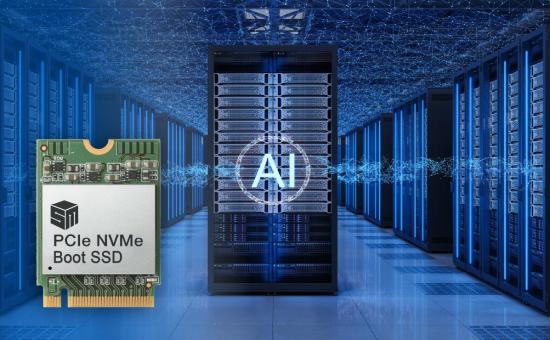
New Challenges Driven by the Evolution of AI Infrastructure
The rapid advancement of generative AI and large language models (LLMs) is driving a new wave of upgrades across global data centers and AI infrastructure. Over the past several years, industry attention has largely focused on GPU compute performance, HBM capacity, and high-speed interconnect technologies. However, as AI clusters continue to scale, system competitiveness is no longer determined solely by compute nodes. Increasingly, it depends on the deployment efficiency, manageability, and long-term operational capabilities of the entire infrastructure.
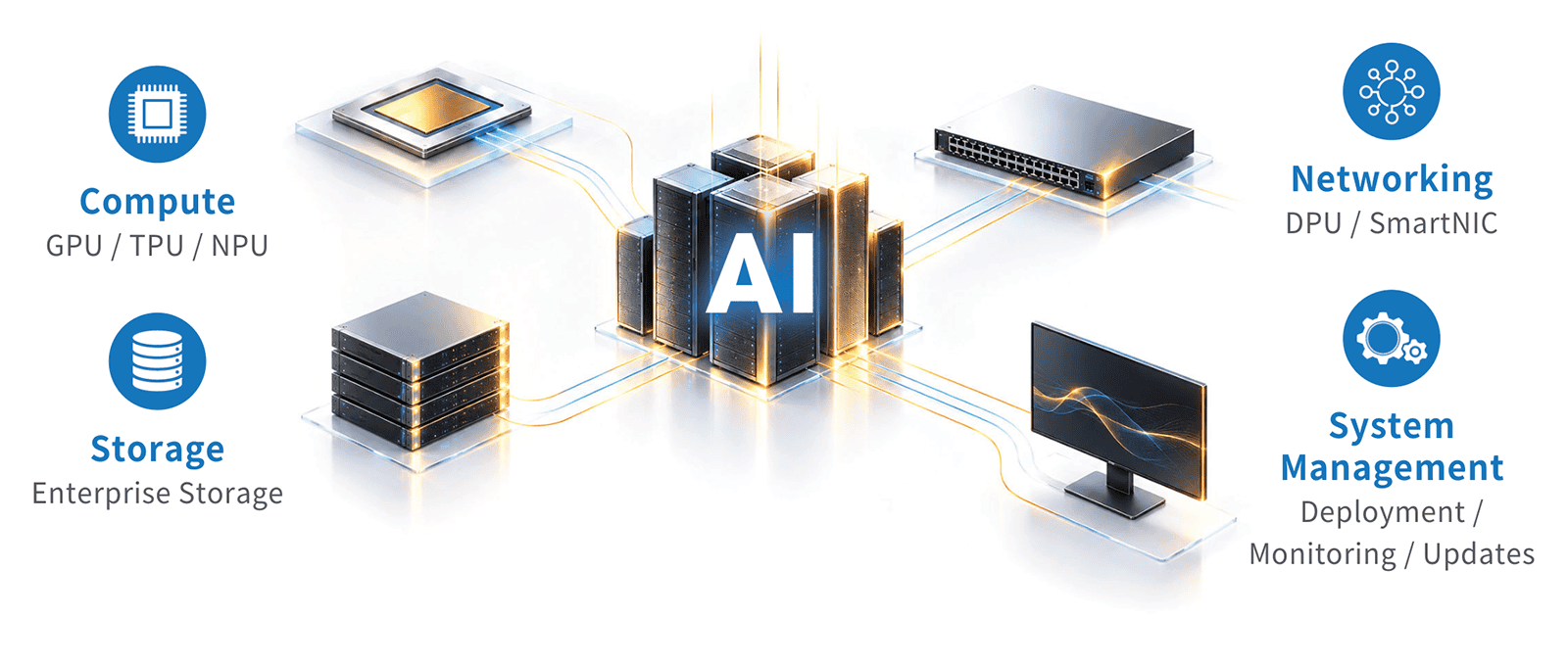
Modern AI data centers often consist of large GPU clusters with hundreds or even thousands of compute nodes interconnected through high-speed networks, distributed storage, and sophisticated management systems. As AI workloads grow in scale and complexity, AI infrastructure is expanding beyond GPU-centric computing to encompass compute, networking, storage, and system management as an integrated architecture.
AI accelerators such as GPUs, TPUs, and NPUs, along with infrastructure components such as DPUs and SmartNICs, are also integrating more compute, data processing, management, and security capabilities. As a result, they are evolving from single-purpose hardware components into more capable, programmable, and highly integrated system platforms.
AI infrastructure is therefore transitioning from a hardware-centric model toward a software-centric architecture. Future competitiveness will depend not only on who has the fastest GPUs, but also on who can build an overall platform that is easier to deploy, manage, update, and operate reliably.
As AI infrastructure becomes increasingly software-defined, the role of boot storage is also changing. Once used primarily to store boot images, boot storage is evolving into a critical storage foundation for operating systems, management software, system images, and operational data, supporting deployment, updates, and day-to-day operations across AI infrastructure.
Software-Defined AI Infrastructure Drives New System Storage Requirements
As AI infrastructure rapidly evolves, compute, networking, storage, and management systems are no longer responsible for a single control function. Increasingly, these systems must support a broad range of software services, including virtualization, network acceleration, security, telemetry and monitoring, automated deployment, and remote management.
As a result, these devices must run complete Linux operating systems, container runtimes, management agents, security modules, and diagnostic tools, driving continued growth in both system software and associated storage requirements. Beyond the increasing software footprint, systems must also retain large volumes of container images, system logs, telemetry data, configuration data, backup images, and diagnostic information to support routine operations and rapid recovery from failures.
At the same time, software update frequency in AI data center equipment is significantly higher than in traditional infrastructure. System image deployment, security patching, version rollback, remote updates, and automated management have all become routine elements of AI infrastructure operations. Consequently, the competitiveness of AI data center equipment increasingly depends on the ability to manage the entire software lifecycle, rather than simply providing reliable system boot functionality.
From System Boot to Software Operations: The Evolving Role of Enterprise Boot Drives
Within AI infrastructure, enterprise boot drives can store not only operating systems and system images, but also container runtimes, management services, telemetry data, logs, diagnostic information, backup images, and system updates. Their role is therefore expanding beyond basic boot storage to become an important storage foundation supporting software deployment, updates, and ongoing system operations.
Beyond providing boot storage, enterprise boot drives can support a comprehensive range of software lifecycle and operational functions, including:
- Software Deployment
- Remote Software Updates
- Telemetry & Event Logging
- System Image Management
- Rollback & Recovery
- Health Monitoring
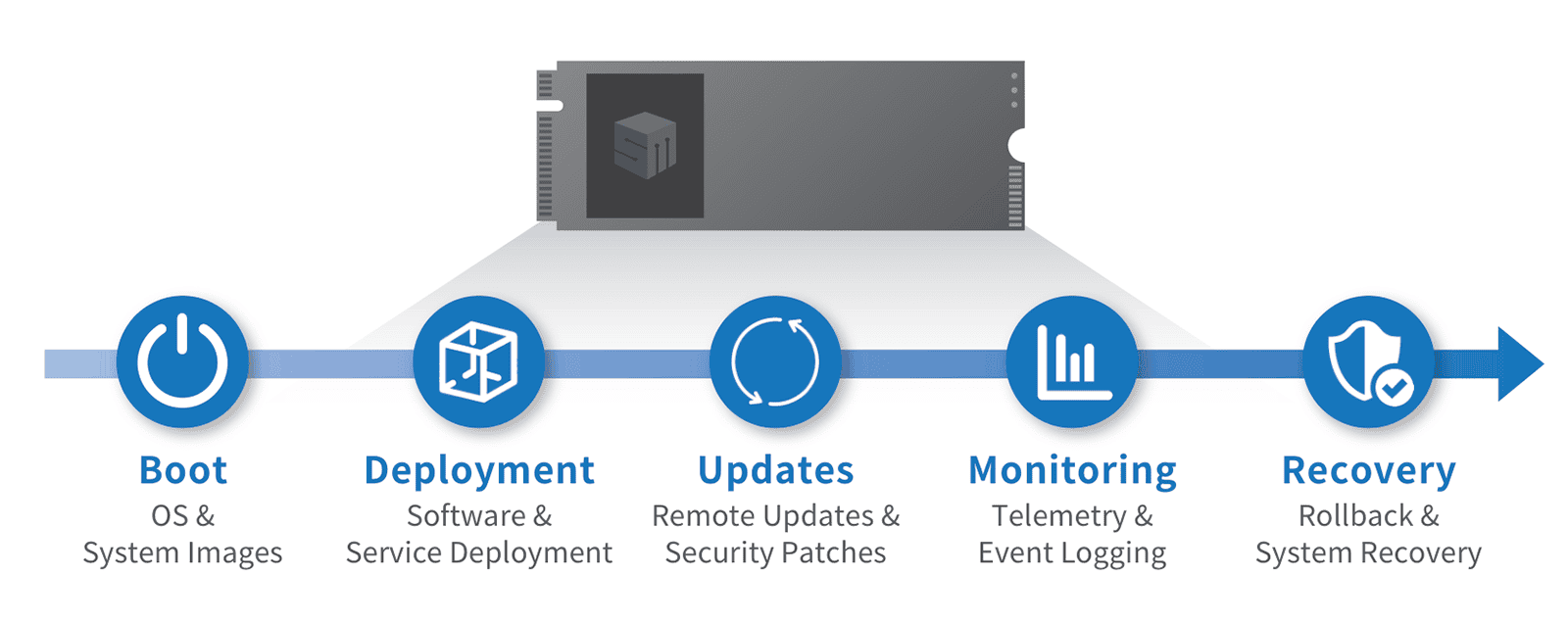
As a result, the value of enterprise boot drives extends beyond simply enabling systems to boot reliably. They also play an important role in ensuring that the overall AI platform can operate continuously, securely, and efficiently.
The Critical Role of Enterprise Boot Drives in AI Infrastructure Operations
Across modern AI infrastructure—from core compute nodes to control and management, storage, and networking systems—enterprise boot drives play an important system storage role by providing a reliable boot environment and hosting system software, management tools, and operational data.
AI Compute Servers
AI compute servers are at the core of AI infrastructure, using accelerators such as GPUs, TPUs, and NPUs to perform large-scale model training and inference. In addition to the compute engines, these systems must load operating systems, accelerator drivers, AI software stacks, container runtime environments, and various management applications.
As AI software environments become increasingly complex, enterprise boot drives are no longer simply boot devices. Instead, they provide dedicated storage for system software and operational environments, increasing requirements for reliability, capacity, endurance, and long-term operational support.
AI Networking and Infrastructure Systems
AI clusters also rely on high-speed networking and infrastructure technologies, including Ethernet, InfiniBand, and systems based on DPUs or SmartNICs, to enable high-speed data exchange among large numbers of compute nodes and storage devices.
As these devices host increasingly sophisticated networking, management, security, and infrastructure software, enterprise boot drives can provide persistent storage for operating systems, network operating systems (NOS), firmware, management software, telemetry data, and logs. Because these systems often operate under strict space, power, and thermal constraints, low power consumption, compact form factors, and effective thermal management are increasingly important alongside reliability and endurance.
AI Control and Management Servers
Large AI clusters rely on control and management servers for resource scheduling, workload orchestration, node management, system monitoring, and operations, enabling large numbers of compute nodes to work together efficiently.
Enterprise boot drives in these systems must host not only the operating system and cluster management software, but also configuration data, telemetry information, and continuously generated system logs. Because control and management nodes directly affect the availability of the entire AI cluster, enterprise boot drives for these applications place particular emphasis on reliability, data integrity, endurance, power-loss protection (PLP), and security.
AI Storage Servers
AI training and inference require massive volumes of datasets, models, checkpoints, and other AI workload data. Modern AI infrastructure therefore typically includes dedicated storage servers or software-defined storage (SDS) nodes.
While large volumes of AI data are primarily stored on data drives, enterprise boot drives independently host the operating system, storage software, system configurations, and operational data, separating the system layer from the data layer. This architecture helps improve system stability and serviceability while placing greater requirements on enterprise boot drives for reliability, endurance, power-loss protection, and data integrity.
Enterprise Boot Drive Applications in AI Servers and AI Infrastructure
| AI Infrastructure Type | Typical Systems / Platforms | Primary Functions | Primary Boot Drive Workloads | Key Boot Drive Requirements |
|---|---|---|---|---|
| AI Compute Servers | GPU / TPU / NPU servers · AI training / inference servers | AI model training and inference | Operating system · Drivers · AI software stack · Container runtime · Logs | Fast boot / system access performance · Capacity · Endurance · Reliability |
| AI Networking and Infrastructure Systems | DPU / SmartNIC systems · AI networking equipment · Ethernet / InfiniBand infrastructure | AI cluster networking · Data transfer · Infrastructure services | Operating system / NOS · Firmware · Infrastructure software · Telemetry data · Logs | Low power · Endurance · Reliability · Security |
| AI Control and Management Servers | Management nodes · Control nodes · Orchestration servers | Cluster management · Resource scheduling · System monitoring and control | Operating system · Cluster management software · Orchestration software · Telemetry data · Logs | Reliability · Endurance · PLP · Security |
| AI Storage Servers | Storage servers · SDS nodes · AI data storage nodes | Storage of datasets · Models · Checkpoints · Other AI data | Operating system · Storage software · System configurations · Telemetry data · Logs | Endurance · Reliability · PLP |
Intelligent Management and Data Protection for Enterprise Boot Drives
Silicon Motion's enterprise boot drive solutions leverage a PCIe Gen4 NVMe architecture and are available in multiple form factors, including BGA SSD and M.2, to address diverse system design requirements for capacity, space constraints, power consumption, and serviceability. To support the 24×7 operation and long-term operational requirements of AI data centers, these solutions integrate enterprise-grade data protection, security mechanisms, and intelligent management technologies. These capabilities span NAND data protection, end-to-end data path protection, and system monitoring, further enhancing the long-term reliability, data integrity, and manageability of enterprise boot drives.
IntelligentSeries™
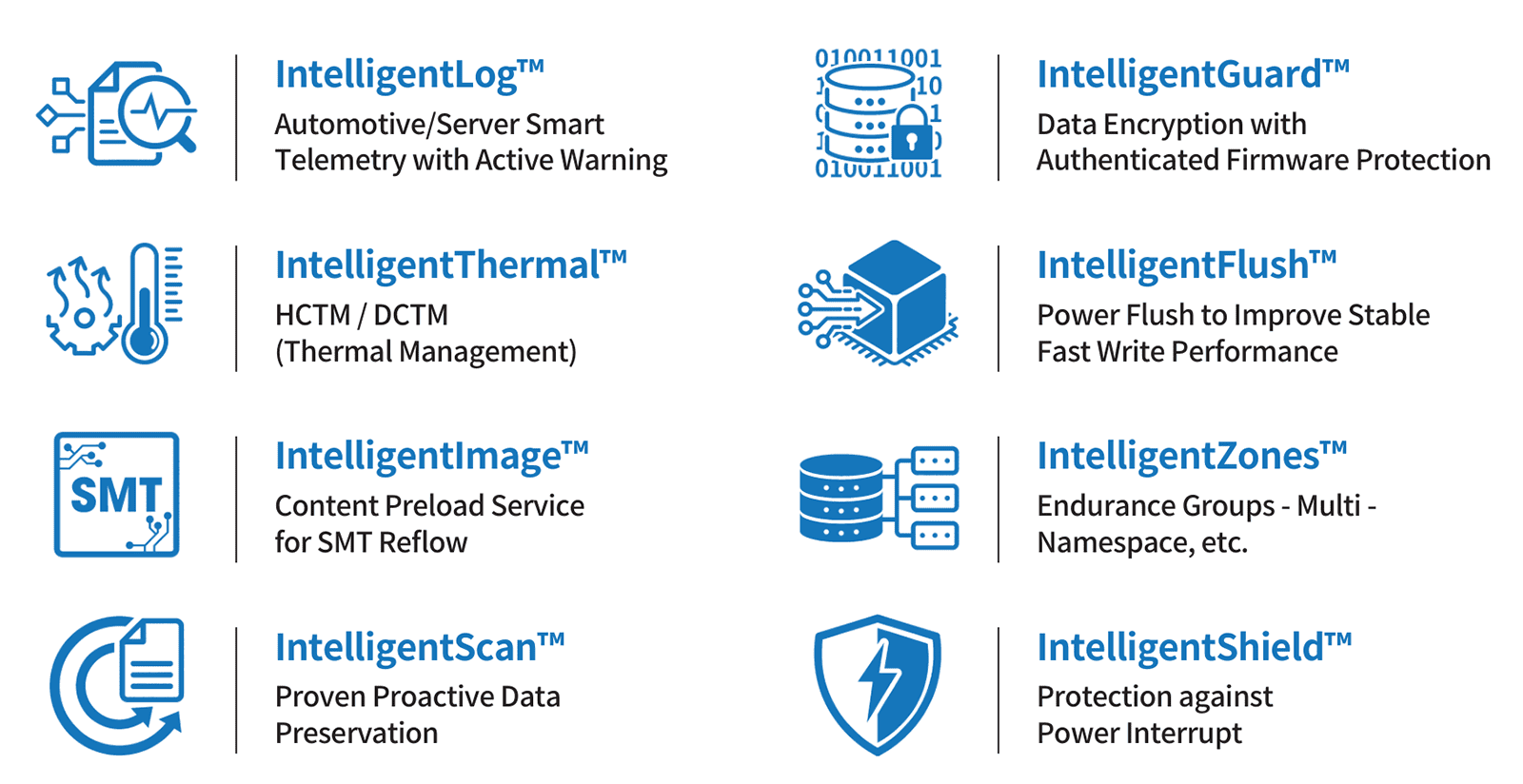
In large-scale AI infrastructure, the ability to monitor storage devices in real time, rapidly diagnose issues, and perform proactive management is becoming increasingly important for reducing operational complexity and minimizing the risk of system downtime. Silicon Motion's proprietary IntelligentSeries™ technology integrates a range of intelligent management and protection capabilities, enabling enterprise boot drives to go beyond passive data storage and provide greater visibility into device health and operating conditions.
Through capabilities such as telemetry, event logging and tracking, firmware verification, unexpected power-loss protection, and proactive thermal management, system administrators can gain greater visibility into SSD health, temperature, abnormal events, and operational status, helping facilitate issue analysis and preventive maintenance. For AI data centers with large numbers of nodes operating 24×7, these capabilities can further enhance infrastructure observability, manageability, and long-term reliability.
End-to-End Data Path Protection
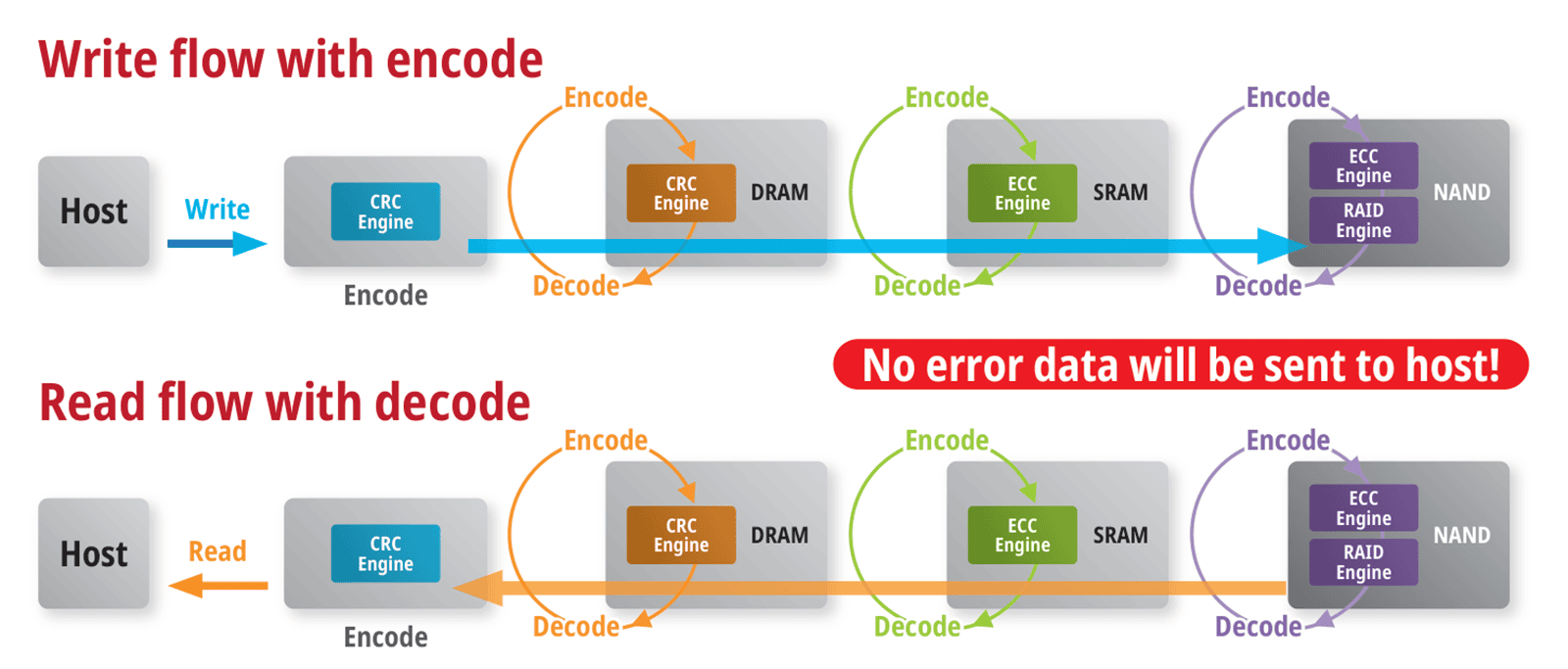
The operating systems, system images, configuration data, and management data stored on enterprise boot drives are essential to reliable system startup and operation. Data integrity protection therefore must extend beyond the data stored in NAND to cover the entire data path from the host through the SSD to NAND Flash.
Silicon Motion's enterprise boot drive solutions incorporate End-to-End Data Path Protection to detect errors and verify data integrity as data travels between the host, SSD controller, internal memory, and NAND Flash. Through data integrity checking mechanisms such as CRC, the technology helps reduce the risk of data corruption caused by unexpected errors during data transfer, processing, or storage, ensuring the consistency and integrity of critical system data throughout write and read operations.
NANDXtend® ECC
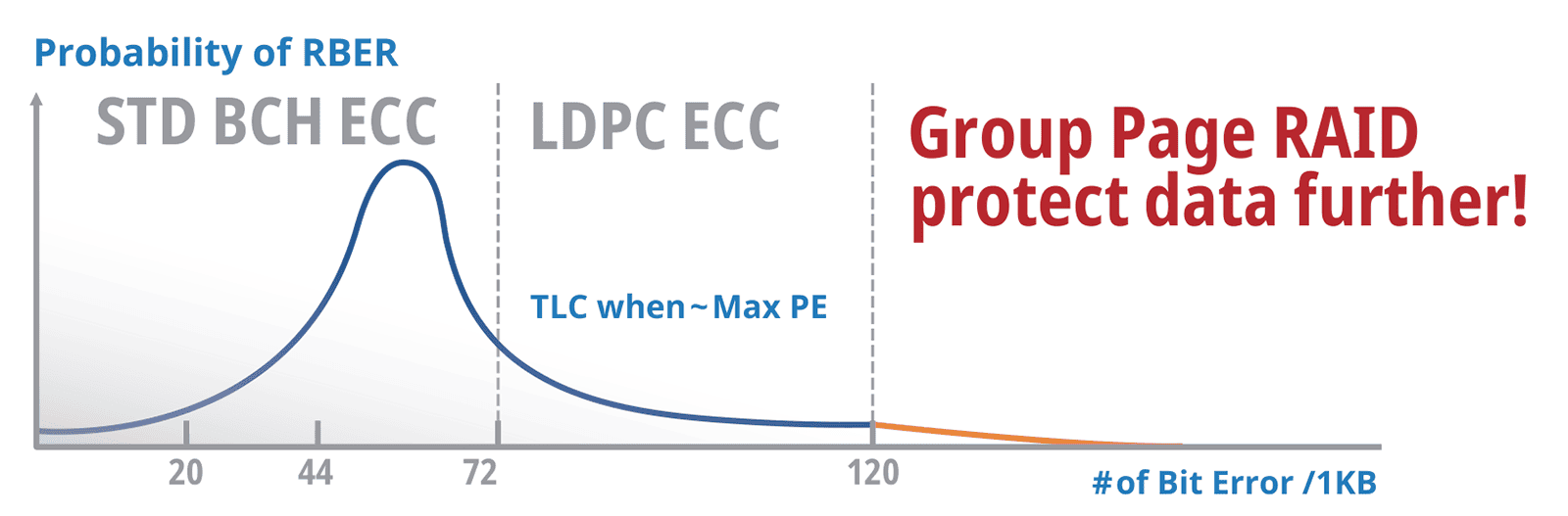
As NAND Flash continues to increase in density, NAND wear, data retention, and error-rate management over extended periods of use are becoming increasingly important factors affecting SSD lifespan and data reliability. For AI infrastructure designed for continuous, long-term operation, enterprise boot drives must maintain robust data protection throughout their entire service life.
Silicon Motion's proprietary NANDXtend® ECC combines LDPC (Low-Density Parity-Check) error correction technology with RAID data protection mechanisms to enhance NAND error detection and correction while improving fault tolerance against NAND failures. Through multiple layers of data protection, NANDXtend® ECC helps mitigate the impact of NAND wear on data integrity and extend the effective service life of SSDs, enabling enterprise boot drives to maintain the reliability of critical system data even after prolonged write activity and repeated updates.
From device health monitoring and data path protection to NAND Flash data integrity and endurance management, Silicon Motion's enterprise boot drive solutions employ multiple layers of intelligent management and data protection to enhance the reliability and serviceability of system storage. As AI infrastructure continues to scale and become increasingly software-defined, reliable and manageable enterprise boot drives will become an important foundation for long-term system deployment, updates, and operations.
Enterprise Boot Drives: A Critical Foundation for Long-Term AI Infrastructure Operations
As AI infrastructure evolves toward large-scale deployment and increasingly software-defined architectures, system competitiveness is no longer determined solely by GPU count and compute performance. The ability to deploy systems rapidly, continuously update software, manage infrastructure efficiently, and recover quickly from failures is becoming increasingly important to AI infrastructure availability and operational efficiency.
Across AI compute, control and management, storage, and networking systems, enterprise boot drives provide independent and reliable system storage for operating systems, system images, management software, and operational data, supporting system deployment, updates, monitoring, and failure recovery. As AI infrastructure continues to evolve, enterprise boot drives that deliver reliability, data integrity, security, and manageability will become an increasingly important storage foundation for supporting the system software lifecycle and long-term infrastructure operations.
Contact Us