As AI infrastructure grows in scale and complexity, storage plays a critical role across every layer of the server architecture. While enterprise SSDs are often associated with storing application data, modern servers also depend on storage for system boot, platform management, networking functions, firmware, logging, and service operation.
Each subsystem within a server has unique storage requirements. Some prioritize high capacity and performance, while others require compact form factors, low power consumption, high endurance, or long-term reliability.
Silicon Motion addresses these diverse requirements through a comprehensive portfolio of enterprise SSD controllers, enterprise boot drive solutions and Ferri embedded storage solutions. By matching the right storage technology to each subsystem, server designers can optimize performance, reliability, power efficiency, and board space utilization.
Storage Across the Server Architecture
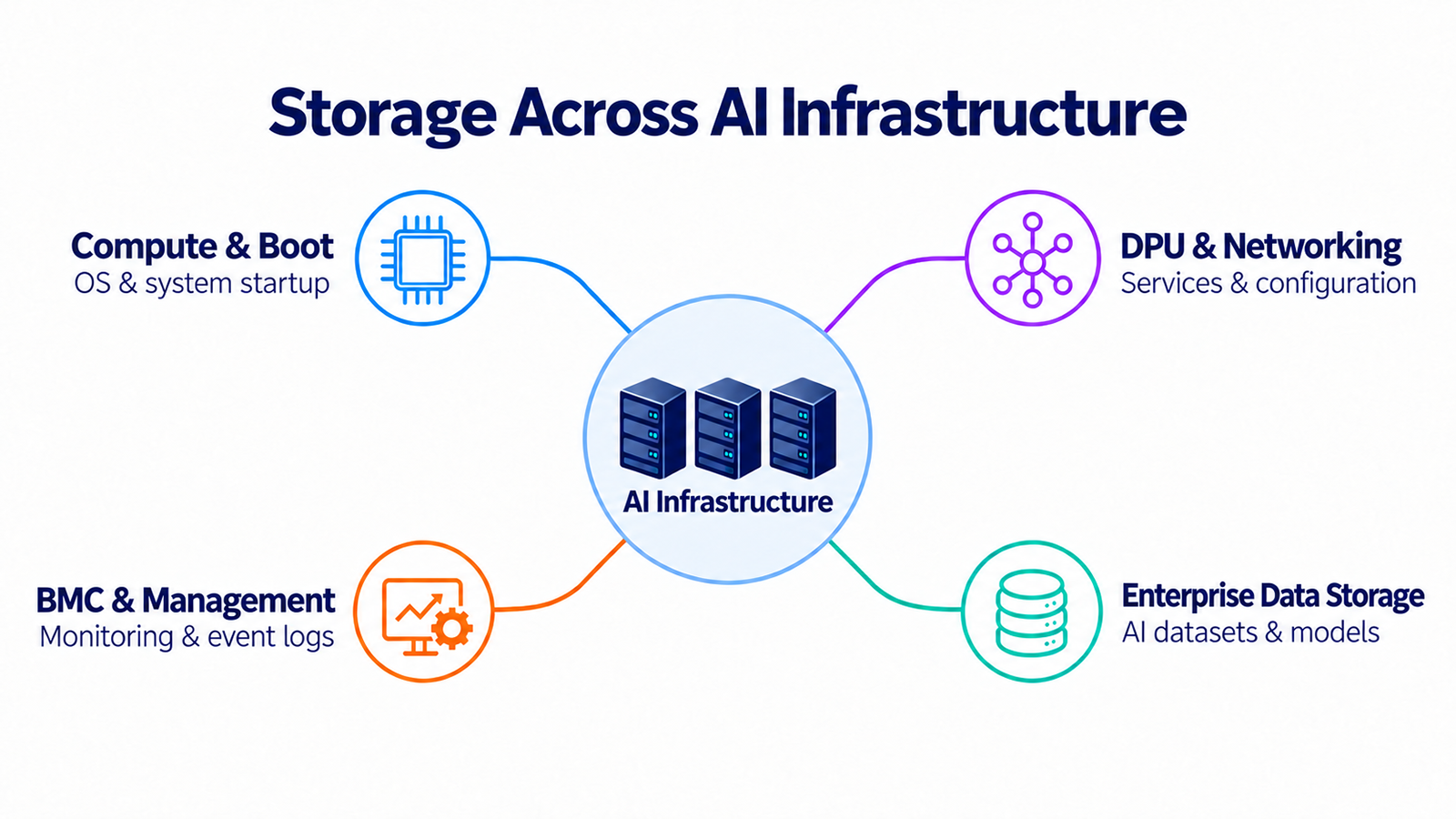
Modern AI and enterprise servers typically include four major storage domains:
- Compute subsystem storage for CPU and GPU boot functions
- DPU and networking subsystem storage for data movement, acceleration, and offload services
- BMC subsystem storage for system management and monitoring
- Enterprise data storage for active workloads, databases, analytics, and AI datasets
Each domain presents unique storage challenges and opportunities.
Compute Subsystems Require Reliable Boot Storage
Powerful CPUs and GPUs are at the heart of modern AI and enterprise servers. Before these processors can execute workloads, they must load operating systems, drivers, firmware, and supporting software from persistent storage.
While boot drives typically require less capacity than primary data storage devices, they must provide:
- Reliable startup operation
- Fast boot-time data access
- Enterprise-grade endurance
- Data integrity and security
- Low power consumption
A failed boot device can prevent an entire server from becoming operational, making reliability a critical requirement.
The Silicon Motion PCIe Gen5 NVMe enterprise boot SSD solutions are optimized for enterprise boot-drive applications. It enables OEM customers to deliver reliable system startup, predictable performance, strong security features, and efficient power operation for CPU- and GPU-based server platforms.
DPUs and Networking Infrastructure Depend on Embedded Storage
As AI clusters continue to grow, efficient data movement has become just as important as compute performance. Data Processing Units (DPUs) have emerged as a key component within modern server architectures, accelerating networking, storage, and security functions while reducing CPU overhead.
DPUs, such as NVIDIA BlueField platforms, integrate networking interfaces, Arm processors, hardware accelerators, PCIe connectivity, and software services into a single subsystem. By offloading infrastructure tasks from the host CPU, DPUs allow compute resources to focus on AI inference and training workloads.
To function properly, DPUs require dedicated persistent storage for:
- Operating systems
- Boot code
- Configuration data
- Security software
- Networking services
- Event logs and diagnostic data
Because DPUs operate in space-constrained environments and typically do not require large storage capacities, embedded storage solutions are often the preferred choice.
Silicon Motion's enterprise boot drive solutions and Ferri embedded storage portfolio is designed specifically for these applications.
The SM681 enterprise boot drive solutions combine managed NAND flash and a PCIe SSD controller within a compact BGA package, providing:
- Simplified design integration
- Reduced PCB footprint
- Industrial-grade reliability
- Extended operational life
The SM662 Ferri-eMMC and SM671 Ferri-UFS solutions deliver a complete managed flash solution that combines NAND, controller, and firmware into a standardized interface that simplifies implementation while ensuring reliable operation.
Together, these boot drive and embedded storage solutions enable DPU manufacturers to implement dependable storage with minimal design complexity.
BMC Subsystems Need Dependable Embedded Storage
Every server contains a Baseboard Management Controller (BMC), which provides out-of-band management capabilities independent of the host operating system.
The BMC is responsible for critical functions such as:
- Remote server monitoring
- System health reporting
- Firmware management
- Power control
- Security oversight
- Event logging
Because the BMC operates continuously and independently from the host processor, its storage must remain highly reliable and always available.
BMC storage requirements typically include:
- Firmware storage
- Configuration files
- Operating system images
- System logs
- Diagnostic information
Embedded storage solutions are ideal for these applications because they combine reliable flash management, compact size, and consistent operation.
Silicon Motion's FerriSSD, Ferri-eMMC, and Ferri-UFS products provide BMC designers with integrated storage solutions that simplify development while ensuring dependable access to critical management data.
Enterprise SSDs Power AI and Data-Centric Workloads
The largest storage requirement within most servers resides in the primary data storage subsystem. These drives store and deliver the data sets, databases, applications, and AI models needed by modern workloads.
Enterprise SSDs deployed in this layer must deliver:
- High throughput
- Low latency
- High endurance
- Strong reliability
- Predictable quality of service
- Enterprise-grade security
Storage deployments vary widely and may include:
- AI training clusters
- AI inference platforms
- Database servers
- Cloud infrastructure
- Enterprise applications
- Content delivery systems
- Nearline storage environments
Nearline storage plays an important role by bridging high-performance compute storage and long-term archival infrastructure, balancing performance and capacity requirements.
Silicon Motion's enterprise SSD controller portfolio enables SSD manufacturers to address a wide range of performance and capacity targets:
SM8366
A high-performance PCIe Gen5 enterprise SSD controller designed for demanding AI, cloud, and hyperscale deployments.
SM8466
The next generation PCIe Gen6 data center SSD controller optimized for enterprise environments that require strong performance, reliability, and scalability.
SM8308
A cost-effective PCIe Gen5 SSD controller that balances performance, power efficiency, and total cost of ownership.
Together, these solutions enable enterprise SSD manufacturers to build products that address diverse server and data center requirements.
The Right Storage for Every Server Subsystem
Different server subsystems require different storage technologies. Selecting the right solution for each application helps maximize system efficiency, reliability, and performance.
| Server Subsystem | Storage Requirement | Silicon Motion Solution |
|---|---|---|
| CPU/GPU Boot Storage | Reliable OS and firmware startup | PCIe Gen5 NVMe Boot SSD Solution |
| DPU Infrastructure | Embedded operating systems, services, and configuration storage | Enterprise boot drive solutions, Ferri-eMMC, Ferri-UFS |
| BMC Management | Firmware, logging, and management software storage | FerriSSD, Ferri-eMMC, Ferri-UFS |
| Enterprise Data Storage | High-performance workload and dataset storage | SM8366, SM8466, SM8308 SSD Controllers |
Building the Next Generation of AI Infrastructure
Modern servers rely on multiple storage layers working together to keep systems operational and manageable. Boot storage enables server startup, embedded storage supports management and networking subsystems, and enterprise SSDs provide the performance and capacity required for AI and data-intensive workloads.
With a portfolio spanning enterprise SSD controllers, enterprise boot drive solutions and Ferri embedded storage products, Silicon Motion provides storage solutions optimized for every major server subsystem. This breadth enables system architects, OEMs, and SSD partners to design reliable, efficient, and scalable infrastructure for the next generation of AI and data center deployments.
Through its global ecosystem of SSD manufacturing partners, Silicon Motion also gives customers the flexibility to select solutions that align with deployment requirements, regional supply chains, and performance objectives, helping accelerate time-to-market while reducing design complexity.
Contact Us