Humanoid Robotics in the Context of Industry 5.0
Humanoid robots can offer important benefits in environments that demand more than automation. Bringing autonomy and adaptability, they have the added potential to interact physically with humans in a natural way, provided safety can be assured. Factories are ready for them now, as the transition from Industry 4.0 to Industry 5.0 presents new challenges that require robots to operate as collaborative agents within unstructured and dynamic workspaces.
Where Industry 4.0 focused on fixed-function systems and cloud infrastructure, Industry 5.0 shifts the emphasis to edge processing, real-time responsiveness, and energy efficiency. For humanoid robots, this entails running complex AI inference, integrating multimodal sensor input, and facilitating safe interaction, all within stringent thermal and power constraints.
These requirements are not just compute-centric. They place significant demands on embedded storage to support low-latency access, intelligent fault logging, and power-aware operation, while occupying minimal critical board space.
Robotic Architectures Require Synchronised Subsystems
A humanoid robot functions as an integrated platform for several high-performance domains that must operate in continuous synchrony. Its perception systems rely on high-resolution camera arrays, LIDAR, and inertial sensors to construct an accurate and responsive understanding of the environment. Speech recognition and natural language processing modules enable voice-driven interaction and contextual awareness, while motion control systems coordinate bipedal locomotion, manipulation, and fine motor actuation. Core AI inference engines execute behaviour generation, path planning, and decision-making at the edge, often under stringent timing constraints.

Supporting these capabilities are onboard data logging and diagnostic systems that record system events, anomalies, and operational metrics. All of these subsystems must communicate and execute with sub-millisecond precision. Visual data must enter inference pipelines without delay, actuator commands must reflect real-time sensor input, and system health analytics must be processed concurrently with mission tasks. Meeting all these demands requires embedded storage solutions that combine consistent latency, power efficiency, and intelligent subsystem coordination. Silicon Motion’s Ferri Embedded Storage portfolio is specifically engineered to meet these conditions in compact, high-reliability applications.
Storage as a System-Level Enabler
Embedded storage in humanoid robotics is not confined to handling boot processes or static application data. It plays an active role in executing critical system functions. Real-time image and sensor streams must be captured continuously and processed with minimal latency to ensure seamless operation. AI inference engines rely on rapid model loading and access to locally stored datasets. Subsystem activity requires persistent logging, both for runtime coordination and post-deployment analysis. Firmware and model updates are delivered over-the-air, often during active use, demanding seamless read-write performance. In parallel, diagnostic data must be recorded and accessed in response to specific triggers, supporting predictive maintenance and system-level fault recovery.
Meeting these operational demands requires more than basic throughput. Embedded storage must provide consistent performance, power-efficient operation, and the ability to synchronise with other real-time components, all within the physical and thermal constraints of compact robotic designs.
Ferri Embedded Storage from Silicon Motion
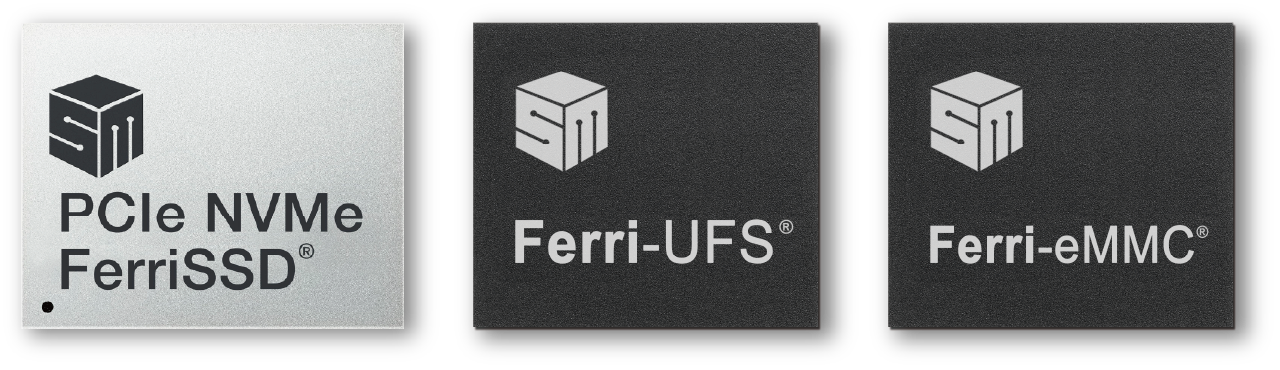
Silicon Motion’s Ferri product family provides fully integrated embedded storage solutions, combining a Silicon Motion controller, NAND flash, and firmware into a single compact BGA package. The product line includes FerriSSD®, Ferri-UFS®, and Ferri-eMMC®, each engineered for specific performance and integration needs.
FerriSSD: PCIe® Gen4 Performance for AI and Logging Applications
FerriSSD supports PCIe® Gen4 and is specifically engineered for subsystems that handle compute-intensive tasks and continuous high-volume logging. It performs exceptionally well in scenarios where large AI models, such as LLMs and transformer-based architectures, must be hosted locally to support autonomous operation. The device also meets the demands of event-driven data capture for compliance and system-level diagnostics, ensuring that every inference result, control decision, and anomaly can be persistently recorded without degrading performance. In applications where decision-making is centralised—such as path planning, safety control, or task prioritisation—FerriSSD provides the sustained bandwidth and low-latency responsiveness needed to maintain deterministic behaviour. Its firmware is optimised for stable performance over time, with onboard temperature sensing and intelligent workload regulation ensuring thermal consistency even under prolonged, compute-heavy workloads.
Ferri-UFS: Designed for High-Throughput Sensor and AI Subsystems
Ferri-UFS supports workloads that require sustained, low-latency data transfer. It supports UFS 3.1, offering:
- Read speeds up to 1600 MB per second
- Write speeds up to 800 MB per second
- Support for command queuing and parallel access
These capabilities make it well suited for AI-based perception stacks, including real-time object recognition, multi-camera input, and simultaneous localisation and mapping. Its low access latency and high concurrency enable inference engines to respond to the environment without delay.
Ferri-eMMC: Power-Efficient Precision for Control and Interface Modules
Ferri-eMMC meets the eMMC 5.1 specification and is well suited to subsystems that do not require maximum throughput but demand consistent response times and long-term durability. It is an ideal choice for motion control processors, where precise timing and low-latency command execution are critical. The same applies to voice command interfaces, which must support reliable, always-on processing for wake-word detection and spoken input. In human-machine interface modules such as touchscreens and feedback displays, Ferri-eMMC enables responsive interaction without adding unnecessary cost or complexity. Despite its compact and power-efficient design, Ferri-eMMC incorporates the same intelligent firmware found in higher-tier Ferri products, supporting unified diagnostics, system health monitoring, and predictable integration across all subsystems in the robot architecture.
Embedded Intelligence for Predictable Operation
Ferri products provide more than flash storage. They include firmware-level intelligence designed to support system stability, fault recovery, and predictive diagnostics. Two key features are IntelligentLog™ and IntelligentThermal™.

IntelligentLog™: High-Frequency Logging and Predictive Diagnostics
Traditional software-based logging systems in embedded robotics can introduce latency and are prone to data loss in the event of faults. IntelligentLog™ eliminates these limitations by offering:
- Structured, high-frequency logging partitions
- Timestamped indexing of events across all subsystems
- Real-time endurance monitoring with host notifications
- Automatic relocation of critical logs during degradation
This enables engineers to maintain a comprehensive operational record, support OTA model optimisation, and conduct rapid fault isolation with minimal host overhead.

IntelligentThermal™: Dual-Mode Thermal Regulation
Thermal budgets in humanoid robots are shared across AI compute, actuators, and sensor modules. Storage that cannot respond dynamically to heat may contribute to system-level instability. IntelligentThermal™ provides two independent modes of regulation:
- Host-Controlled Thermal Management (HCTM) allows the system processor to adjust workloads based on live thermal data
- Drive-Controlled Thermal Management (DCTM) allows the Ferri storage device to autonomously throttle or redistribute workloads when host intervention is unavailable
This dual-mode regulation ensures that storage performance remains consistent, even during prolonged AI processing or high-frequency motor activity in limited-airflow enclosures.
Subsystem Mapping and Integration Strategy
With their defined feature sets, these different types of storage can bring specific advantages to various functions of the robot, such as motor control, voice recognition, machine vision, activity detection, and handling large language models. The storage can be mapped to roles in humanoid robots, as described in the table.

This modular mapping allows design engineers to tailor storage selection to individual subsystem requirements while maintaining a common firmware base and thermal management strategy.
Designed for Industrial Robotics and AIoT Deployments
Ferri products are engineered for deployment in demanding edge environments where long-term reliability is critical. Each device is qualified for a wide operating temperature range, from -40 to 105 degrees Celsius, ensuring stable performance in both industrial and outdoor conditions. Built-in power-loss protection and high write endurance allow Ferri solutions to withstand the continuous logging and model-updating demands of autonomous systems. Advanced error correction capabilities, including LDPC-based ECC, maintain data integrity even under write-heavy workloads. Their compact BGA packaging simplifies mechanical integration and supports rapid qualification across a broad range of embedded platforms. Ferri storage is already in use across industrial automation, automotive edge computing, and AIoT systems, where consistent field performance under sustained operation is essential.
Conclusion
Controlling humanoid robots requires complex, real-time coordination across multiple subsystems that are subject to tight constraints on size, power consumption, and thermal performance. Meeting these objectives calls for synchronisation, real-time AI execution, and safe performance in diverse, unstructured, and continually changing conditions. The demands placed on system storage extend beyond simply providing capacity. Storage devices must act as system-aware components that support reliability, lifecycle management, and stability over a wide operating-temperature range.
Silicon Motion’s Ferri embedded storage solutions provide a compact, intelligent, and high-performance platform for robotics engineers. Whether deployed in vision systems, AI cores, control loops, or data loggers, Ferri enables consistent and efficient operation with minimal integration overhead.
For design teams seeking to accelerate humanoid robot development and streamline embedded storage selection, Ferri offers a proven path to deployment.
Contact Us