This article was originally published on All About Circuits by Jason Chien from Silicon Motion.
Contact UsLearn how to solve QLC NAND's endurance, ECC, and performance issues for hyperscale. The approach blends a PCIe Gen5 controller with hardware-accelerated LDPC, PerformaShape QoS, and more.
Hyperscale data centers and AI infrastructure economics increasingly favor QLC (Quad-Level Cell) NAND. Its cost-per-bit advantage, combined with continually increasing layer counts and die-level density, makes it an attractive candidate to replace legacy HDDs and reduce the footprint of enterprise flash deployments. Yet these advantages come with compromises that are not easily ignored, especially regarding endurance, error correction, and performance consistency.
With workloads shifting toward AI pipelines and multi-tenant environments, storage systems are being held to a new standard. Beyond capacity or peak throughput, storage is now judged on its ability to deliver deterministic behavior under diverse and unpredictable IO patterns. Traditional SSD architectures are failing to scale QLC across modern, multi-petabyte deployments.
Fortunately, Silicon Motion offers a path forward for QLC with MonTitan, a PCIe Gen5 platform developed to address these exact challenges. Through architectural advancements in the controller ASIC and improved firmware modularity, MonTitan makes QLC a viable foundation for enterprise-grade SSDs, capable of reaching 256 TB and beyond.
The Economics and Challenges of Scaling QLC SSDs
As hyperscalers push for greater storage density at lower cost, QLC SSDs offer many clear advantages. Compared to TLC (Triple-Level Cell), QLC reduces cost per bit by storing four bits per cell, which slashes the number of dies needed per terabyte. In large AI data lakes and storage-intensive applications, this translates into a reduced rack footprint, lower power consumption per terabyte, and improved cost efficiency at scale.
However, the physical characteristics of QLC NAND also introduce significant trade-offs. Narrower voltage margins between states reduce endurance and increase susceptibility to charge leakage and retention loss. Each program and erase cycle becomes more error-prone and demands sophisticated error correction schemes to maintain data integrity. These effects compound as the NAND layer counts grow and cells become more tightly packed.

Such reliability challenges also have architectural consequences in SSD controllers. SSDs must implement stronger LDPC (Low-Density Parity-Check) schemes with higher compute overhead to compensate for the higher error rate. For large capacity SSDs, the logical-to-physical mapping tables also balloon in size with capacity and drive-up DRAM requirements.
From a performance standpoint, AI data workloads further stress QLC SSDs with fragmented and random IOs. These behaviors aggravate write amplification and introduce latency variability that traditional SSDs are not equipped to contain.
The Problem with Conventional SSD Architectures
Traditional SSD architectures were never optimized for the characteristics of QLC NAND. Originally built to handle TLC or even MLC (Multi-Level Cell) flash, these designs rely on error correction schemes that cannot keep pace with the ever-increasing Raw Bit Error Rate (RBER) in high-layer QLC.
Standard LDPC implementations, for instance, lack the compute throughput and precision required to correct QLC errors without incurring significant latency penalties. As the raw bit error rate rises with layer count and tighter cell packing, error correction must operate with higher decoding iterations and more redundancy. This consumes controller resources and lengthens IO paths, negatively impacting throughput and latency variability.
Conventional SSD architectures are also limited by a lack of IO isolation and performance shaping techniques, and fail to distinguish between sequential training data writes, random inference reads, and metadata updates. The result is unpredictable tail latency and degraded QoS in environments within AI pipelines operating under tight timing constraints.
Write amplification remains another persistent challenge. Because QLC NAND performs poorly with small or misaligned writes, conventional Flash Translation Layer (FTL) schemes often result in frequent garbage collection and block erasure. Ultimately, endurance suffers, and latency spikes during background operations make performance less predictable.
Solving these limitations requires rethinking the entire controller stack from how data is placed on NAND to how performance is guaranteed under real workload conditions.
How MonTitan Re-Architects the QLC SSD Stack
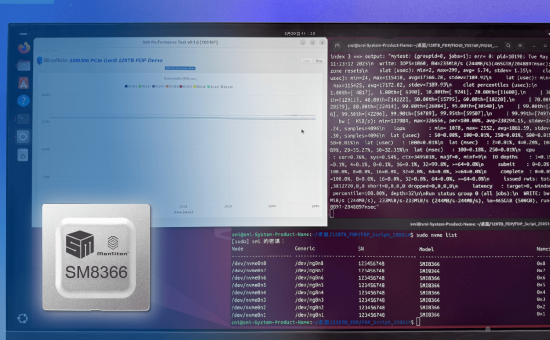
MonTitan addresses conventional SSDs' architectural shortcomings by reengineering the controller and firmware stack. Built around the SM8366 PCIe Gen5 controller, it is designed to handle the elevated ECC (Error Correction Code) requirements, DRAM scaling challenges, and IO variability introduced by dense QLC arrays.
For instance, the platform's NANDCommand engine integrates a hardware-accelerated LDPC architecture with enhanced error correction strength, high surface format efficiency, and higher throughput.
With such a feature, MonTitan can correct QLC-specific errors with minimal latency overhead regardless of NAND density. Whereas legacy LDPC designs degrade under high-layer flash, the MonTitan implementation maintains consistent error recovery time such that the SSD delivers steady performance and long-term data retention.
The SM8366 PCIe Gen5 Controller offers up to 25% improvements inrandom read performance relative to competitors. Image used courtesy of SiliconMotion.

To address the unpredictability of multi-tenant and AI workloads, MonTitan implements PerformaShape, a proprietary technology developed by Silicon Motion. This technology provides a dual-stage performance shaping engine that operates independently of the host.
It dynamically tunes latency, performance like throughput and IOPS (IO Per Second), and queue behavior based on IO pattern detection to isolate read-intensive inference traffic from background write activity.
PerformaShape eliminates the cross-interference that typically plagues shared storage resources, allowing the SSD to uphold consistent quality of service (Quality of Service) across workload types.
MonTitan's architecture is explicitly designed for DRAM and L2P (logical-to-physical) mapping scalability. As SSD capacities approach 256 TB and beyond, the overhead for managing logical-to-physical address translation becomes a system bottleneck.
In response, MonTitan's controller design incorporates a scalable mapping with different IU (Indirection Unit) and a hardware-based accelerating engine that maintains high performance for L2P table lookup and high efficiency memory usage without requiring disproportionate increases in onboard DRAM.
Leveraging Flexible Data Placement
While controller performance and error correction are requisites of QLC viability, write amplification remains one of the most significant barriers to deploying high-capacity QLC SSDs in real-world environments. Conventional FTLs can cause IO fragmentation and randomization in size SSD controllers—the so-called "IO blending issue"—and often struggle with fragmented and random IOs, which leads to inefficient garbage collection and excessive internal data movement.
These behaviors eventually inflate the write amplification factor (WAF), which introduces latency spikes that disrupt workload performance during garbage collection, and reduces SSD life span or DWPD (Data Write Per Day)
To this end, MonTitan integrates Flexible Data Placement (FDP) support. FDP enables the host to dictate how and where data is placed on the NAND, bypassing some legacy abstractions that force SSDs to interpret workloads in generic terms. As such, MonTitan reduces the frequency of page- and block-level rewrites and significantly lowers WAF.

In practice, the SSD performs fewer background operations and requires less translation work for higher sustained throughput and longer endurance. In benchmarked AI inference workloads, FDP has demonstrated write amplification factors near 1.5, an exceptional improvement compared to traditional FTL implementations on QLC NAND.
Notably, FDP becomes particularly powerful when combined with PerformaShape. Together, these technologies allow the drive to respond intelligently to workload intent, shaping IO for consistency while optimizing NAND usage patterns for longevity. The resultant platform helps maintain performance and reliability over time, even as write pressures and capacity demands scale.
Reliability and Security for Long-Term QLC Use
Deploying QLC at enterprise scale demands that storage systems maintain predictable behavior. However, this is particularly tricky when considering years of operation under workloads that can shift from read-heavy inference to write-intensive training without notice. In this context, endurance, data integrity, and system security are non-negotiable.
MonTitan's controller architecture is built for error containment and fault recovery. For example, its LDPC engine supports extended codeword lengths and configurable decoding iterations, which allow it to recover from complex error patterns. The platform also incorporates advanced error monitoring and predictive maintenance mechanisms, which allow system integrators to detect and address wear-out behavior before it impacts application performance.
Security is treated as a hardware-rooted capability in MonTitan. The platform supports data encryption for data on the fly and data at rest with hardware-accelerated symmetric encryption algorithm engines, which can support throughput at line rate.
In addition, the platform supports platform security with a silicon root of trust (RoT), which includes secure boot and attestation. The silicon root of trust (RoT) implements various asymmetric encryption algorithms, including post-quantum cryptographic functions, which cater to the growing need for tamper-resistant storage in AI and cloud environments.
These reliability and security measures collectively help QLC SSDs operate continuously and securely.
Future Outlook
As the NAND roadmap moves toward PLC (penta-level cell) and layer counts exceeding 300, controller-side innovation becomes the primary lever for sustaining performance, reliability, and endurance. MonTitan is engineered to meet this challenge with hardware-accelerated LDPC engines, QoS-preserving performance shaping, and a modular firmware stack that adapts to changing flash dynamics. Collectively, these capabilities make MonTitan perfect for enterprise deployment.
Unlike client-grade QLC solutions that struggle under multi-tenant loads and sustained write activity, MonTitan is designed from the ground up for demanding hyperscale environments. Its enterprise-grade controller architecture isolates noisy neighbors to preserve tail latency, maintains throughput under mixed workloads, and incorporates real-time telemetry and aging-aware data placement to extend usable life. The result is a QLC SSD that behaves like an enterprise-class drive that is predictable, reliable, and cost-efficient at scale.
As a result, cloud service providers running massive AI data lakes, telecoms managing video streaming infrastructure, and government agencies archiving high-resolution imagery all benefit from MonTitan's enterprise-class approach to QLC. Whether the workload is write-heavy, read-dominant, or variable and unpredictable, MonTitan delivers consistent performance and endurance with the density advantages of QLC.
Contact Us