Massive Data Growth, Storage Options and Their Requirements
Massive data growth is not new. It started in the enterprise with the emergence of business intelligence applications and has been compounded by user generated content via smartphones and exponential growth of data collection being done at the intelligent edge.
In 2024, 402.89 million terabytes of data are created, captured, copied, or consumed every day, according to Statista. This adds up to 147 zettabytes of data per year. It's projected to grow to 181 zettabytes by 2025.1 With all this data being ingested by AI data pipelines to create sizeable training models, the demand for storage is unending, and it must be high capacity, secure and efficient from both a data and power perspective.
Data security and privacy is more important than ever, not only because of legislation and regulations that govern how data is handled, but also because AI workloads represent valuable intellectual property.
Security is essential maintain the integrity of the data, which is critical for the AI data pipelines if the training models and ultimate inference are to be trusted. Data accuracy and validity must be ensured throughout the AI data pipeline from the point of ingestion to the final inference. In an AI data pipelines, security must ensure both data protection and platform protection by using data encryption and/or obfuscation techniques to prevent unauthorized access to data and secure boot with root of trust and prevent unauthorized mutable code access with authentication.
SSDs provide software encryption, hardware encryption, and advanced technology attachment (ATA) to secure data and the device from tampering. Software encrypts data on a logical volume using various software programs. AES 256-Bit (Advanced Encryption Standard) is a hardware-based method that uses a symmetric encryption algorithm to divide data into 128-bit blocks and encrypt them with a 256-bit key. Hardware-encrypted SSDs are designed to integrate with the rest of the drive without affecting performance.
Other available data security and privacy features include the Trusted Computing Group (TCG) Opal 2.0 protocol that can initialize, authenticate, and manage encrypted SSDs through usage of independent software vendors. Caliptra, meanwhile, defines core Root of Trust (RoT) capabilities that must be implemented in the System on Chip (SoC) or ASIC of any device in a cloud platform.
With the emergence of quantum computing, post quantum cryptography will become necessary to protect AI data pipelines as traditional cryptography methods will become ineffective.
The shift from core to edge computing supports more real-time inference. Despite the core being larger, the edge is expanding 3-5x faster, increasing storage needs outside data centers to meet AI demands. AI servers typically require two to four times more storage capacity than regular servers. Hard drives are good for storing substantial amounts of static data, while SSDs are ideal for handling data transformation in AI data pipelines.
AI workloads demand increasing memory bandwidth and capacity, as well as quick access to exabytes of data. Storage faces challenges due to intermittent data surges from AI data pipelines and straggler data causing tail latency. Additionally, storage must function efficiently over extended periods.
AI storage is fueling an exponential growth in data that not only requires high-capacity storage but also addresses the cost per terabyte, which is a leading metric for AI SSDs supporting ingest inference and checkpointing stages.
Industry standards enable efficient AI data pipelines
The mature Non-Volatile Memory Express (NVMe) protocol plays a critical role in supporting the AI data pipelines. NVMe SSDs offer the ultra-fast read and write speeds necessary for each step in the data transformation process, as well as parallel data access by using PCIe lanes to enable concurrent read and write operations and optimize data transfer.
NVMe SSDs can handle large data sets in high-performance computing environments where AI and ML models require rapid data access and fast read/write capabilities as well as reduced latency for real-time analytics, whether it's the data center or the edge.
Smart SSD management improves performance, power efficiency
Because SSDs have such a critical role to play in the AI ecosystem, there must be a focus on how flash is managed. Controllers, not just the SSDs themselves, play a role in supporting the AI data pipelines, and are being optimized to enhance storage performance, while the adoption of QLC NAND in NVMe SSDs increases storage capacity at lower costs.
Capacity and fast data movement are not the only requirements AI data pipelines put on storage. Performance per watt has become a key benchmark for storage, especially in data center AI, as are data privacy and security.
Because the AI data pipelines must be fed data quickly, data efficiency is critical, as AI consumes an unprecedented amount of power. From an ASIC perspective, Silicon Motion provide power islands, frequency scaling, fast retry and exit, and low power modes, while optimizing data movement efficiency through industry standard techniques as well as proprietary technology.
AI Data Pipeline for Data Placement and Performance Shaping
Optimizing data placement is crucial for AI data pipelines efficiency. NVME Zone Named Spaces (ZNS) and Flexible Data Placement (FDP) reduce latency, boost performance, and enhance endurance for AI data access. Silicon Motion's MonTitan technology layers these technologies, providing additional capabilities in large-capacity storage.
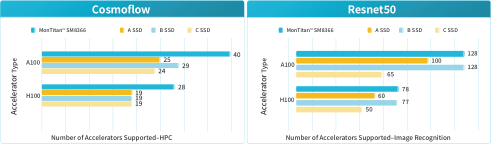
ZNS and FDP ensure proper placement of data at the ingest stage - by being able to accurately place the data where it needs to be, when it needs to be there, there's much less round tripping from a memory perspective, and the GPU are kept as busy as possible.
ZNS-enabled SSDs separate data into zones for more efficient placement and retrieval, reducing internal data movement. ZNS enhances SSD efficiency, longevity, lowers latency, and increases throughput, making them ideal for high-performance AI tasks.
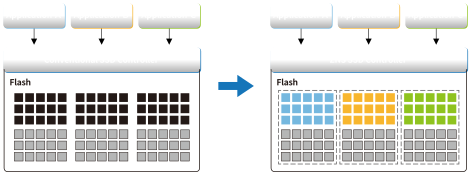
FDP addresses the write-amplification problem in SSDs by allowing the host to have a simplified view and moderate awareness of media topology. An FDP SSD retains control over logical-2-physical mapping, garbage collection and the bad block management of the NAND media. For mixed random and sequential access, FDP optimization reduces write amplification near to one to improve write performance and endurance.
Flexible Data Placement (FDP) Model
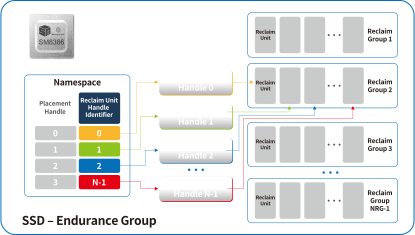
High-capacity SSDs in AI data centers face the IO blender effect due to multi-tenancy or the same storage being accessed by multiple stages of the AI data pipelines simultaneously, where different stages of the AI data pipelines try to access the same data. Silicon Motion's proprietary performance shaping technology reduces these conflicts by dynamically configuring Quality of Service (QoS) sets using a dual stage shaping algorithm tailored for specific workloads in the AI data pipeline.
- Transforming AI Data Pipelines with Advanced SSD Technology (Part1)
- Transforming AI Data Pipelines with Advanced SSD Technology (Part3)
